What to Expect at a Pasta Class in Rome (Honest 2026 Guide)
You booked a pasta class in Rome. You’ve never made pasta before. You’re wondering what actually happens in the kitchen, how long you’ll be there, what to wear, and whether you’ll be hungry afterward (no). Here’s the honest answer, minute by minute — plus what to bring, what to skip, and the small things that make the experience much better.
The short version
- Duration: 2.5–4 hours. Plan your afternoon around it.
- What you’ll make: two pasta shapes (usually fettuccine + one stuffed or filled pasta), often a tiramisu.
- What you’ll eat: everything you made, plus antipasti and wine.
- What to wear: something you can get flour on, closed-toe shoes, hair tied back if long.
- Skill level required: zero.
- You leave with: a full stomach, usually a recipe card or email, sometimes an apron.
Step by step — what actually happens
Arrival and welcome (first 15 minutes)
You arrive at the kitchen — an apartment, a professional kitchen, or sometimes a restaurant that’s been closed for the afternoon. The teacher greets you, pours a small welcome drink (a glass of prosecco, a little wine, sometimes just water with lemon), and gives you an apron. Hair gets tied back. Hands get washed. Introductions, if you’re in a group — usually quick and easy because everyone’s a little nervous.
If the teacher is good, the first five minutes set the tone for the whole class. You’ll notice whether they teach or perform. Teaching is what you want.
Dough time (next 30–45 minutes)
You make dough. In Rome, fresh egg pasta is usually just flour (type 00, sometimes with semolina mixed in) and egg. That’s it. You make a flour volcano, crack eggs in the middle, mix with a fork, knead with your hands until it springs back. It’s physical and slightly meditative. Most people love this part.
The teacher will correct you on technique as you go. Common corrections: don’t over-flour the surface, knead with your palm not your fingers, stop kneading when the dough springs back (“push, it should push back”). After the dough is made, it rests for 20–30 minutes — during which you usually eat a small antipasto and start on the tiramisu or sauce.
Rolling and shaping (next 45–60 minutes)
The best part. The teacher brings out the pasta machine (a hand-crank one — few classes use electric). You cut your dough into portions, flatten each one, and run it through the machine on progressively thinner settings. This is where the class earns its name.
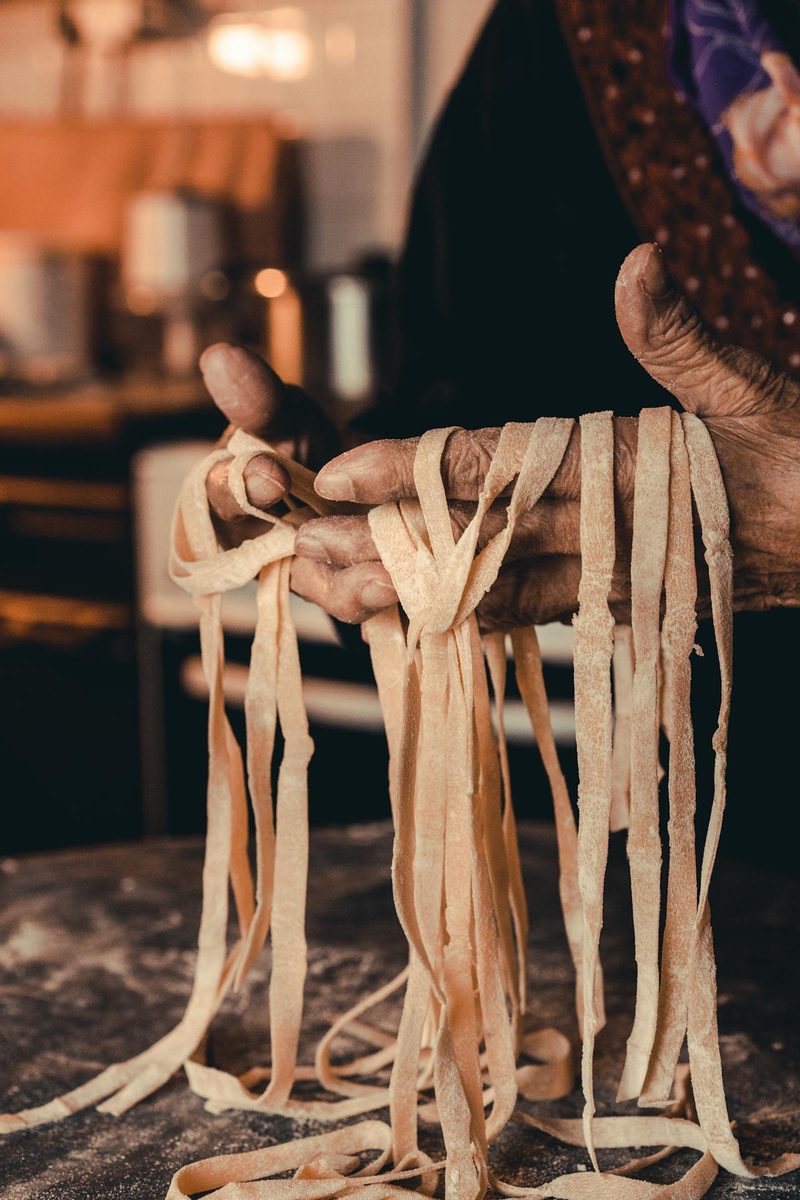
Then you shape. For fettuccine, you fold and cut strips with a knife. For ravioli or tortelli, you spoon filling, fold, seal, cut with a fluted wheel. For orecchiette, tonnarelli, or hand-shaped pasta, the teacher demonstrates and you attempt. Your first few will look terrible. By the fifth, you’ll have the hang of it. By the fifteenth, you’ll be proud.
The pasta you make is the pasta you eat. There’s no swap-out. If your ravioli are ugly, you eat ugly ravioli, and they still taste better than anything you can buy.
Dessert interlude (often earlier — 20–30 minutes)
Most classes include tiramisu. You assemble it between dough resting and rolling — whip mascarpone with egg yolks and sugar, layer with espresso-soaked ladyfingers, dust with cocoa. It goes in the fridge while the pasta happens and comes out at the end. This part feels like a bonus — it’s often the easiest thing you’ll make but the most impressive to take home as a recipe.
Cooking and plating (next 15–20 minutes)
Fresh pasta cooks in 2–3 minutes. The water should be aggressively boiling and well-salted — this is the one “secret” of Italian pasta that everyone underestimates. While yours cooks, the teacher or sous chef is finishing the sauce (carbonara, amatriciana, cacio e pepe, a ragù, a butter-and-sage, or tomato — you’ll usually know which before booking). You drain the pasta, toss it with sauce in a pan for 30 seconds, plate.
The meal (next 45–60 minutes)
You sit down and eat. This is the other half of the class, and the best part of the afternoon. There’s wine (a glass or two is included; more is usually a small upgrade). There’s conversation — with the teacher, with the other students, with yourself if your mouth is too full. There’s tiramisu. There’s often coffee.
If the teacher sits down with you, that’s a green flag — the best classes feel like a dinner party by the end. If they vanish into the kitchen the moment food hits the table, that’s a polite yellow flag.
Wrap-up (last 10 minutes)
Photos. The teacher gives you a recipe card or emails a PDF. You may keep your apron (depends on the operator). You tip (€5–€10 per person is welcomed, not expected). You leave, full, with flour still in your eyebrows, knowing slightly more about pasta and Rome than you did when you arrived.
What to wear
- Clothes you can get flour on. Aprons help a lot but don’t cover everything. Skip the white linen.
- Closed-toe shoes. Required by most operators for hygiene and slip-risk reasons. Sneakers are fine.
- Hair tied back if long. Bring an elastic if you don’t have one in.
- Dress in layers. Kitchens are warm. Outside you may want a light jacket afterward — Rome evenings get cool even in summer.
- Skip jewelry on your hands. Rings and bracelets gum up in dough. Put them in a hotel safe.
What to bring
- Cash for tipping. €10–€20 depending on class size and how great it was.
- A phone for photos. Most classes are phone-friendly; a few ask you to put it away during the cooking portion (and you’ll be grateful — you can’t photograph dough and knead at the same time).
- Your hotel address. If you’re walking back, Google Maps doesn’t always know the narrow Trastevere alleys; it’s good to have a cross-street memorized.
- Dietary notes you’ve already communicated. Even if you wrote them at booking, mention them again at the door. Redundancy prevents errors.
What to skip
- Lunch beforehand. If your class starts at 2pm, eat a croissant at 10am and nothing after. You’ll be eating a full meal by 4:30.
- Expectation of a quick class. Don’t schedule anything within 4 hours of the start time. Classes routinely run 15–30 minutes long, and the meal is the point — don’t race through it.
- Heels, open-toed shoes, or statement outfits. Save those for dinner after.
- Your kid’s tablet. (If you’re bringing kids.) The class handles the attention span problem — the tablet will undermine it.
Things that go wrong (and how to handle them)
- Your dough is sticky. Add a tablespoon of flour, knead it in. This will happen. It’s normal. The teacher will tell you when to stop.
- Your ravioli are sealing badly. Wet the edges with a fingertip of water. Press out the air before sealing. If they open in the pot, you’ll get “rags” — still delicious.
- Your pasta breaks through the machine. You over-flattened. Fold the dough in thirds, start the machine from the thickest setting, work down slowly. Happens to everyone the first time.
- You don’t like the sauce. Tell the teacher at booking. Most can accommodate a sauce swap with 24 hours’ notice. On the day of, it’s usually too late.
Frequently asked questions
Ready to book?
Our full ranked list: the 8 best pasta classes in Rome. By neighborhood: Trastevere, near the Colosseum. By traveler type: with kids, private, gluten-free.
